Search This Blog

Sunday, June 16, 2019

Empowering Ourselves, Empowering Others

This week we read "The Muster of Rohan", during which Theoden and Eomer gather and rally their troops who survived the battles with Saruman (Helm's Deep was not the only battle fought, though it was the largest).  While doing so, a messenger from Gondor comes, begging for them to come at once to its aid.  While they had hoped a week to gather their full strength, such time will not be afforded to them.

Eowyn is appointed to remain at Edoras, despite her obvious desire to ride with them to Gondor.  More surprising, Theoden orders Merry to also remain, since "none of my Riders can bear you as a burden," and "what would you do, Master Meriadoc, sword-thain though you be, greater of heart than of stature."  Though for different reasons than Eowyn, Merry is to be left behind of who he is, and what others assume he is capable of.  But there is a change of fortune.

Merry looked up and saw that it was the young Rider whom he had noticed in the morning.
‘You wish to go whither the Lord of the Mark goes: I see it in your face.’
‘I do,’ said Merry.
‘Then you shall go with me,’ said the Rider. ‘I will bear you before me, under my cloak
until we are far afield, and this darkness is yet darker. Such good will should not be
denied. Say no more to any man, but come!’
‘Thank you indeed!’ said Merry. ‘Thank you, sir, though I do not know your name.’
‘Do you not?’ said the Rider softly. ‘Then call me Dernhelm.’

Merry will get his war.

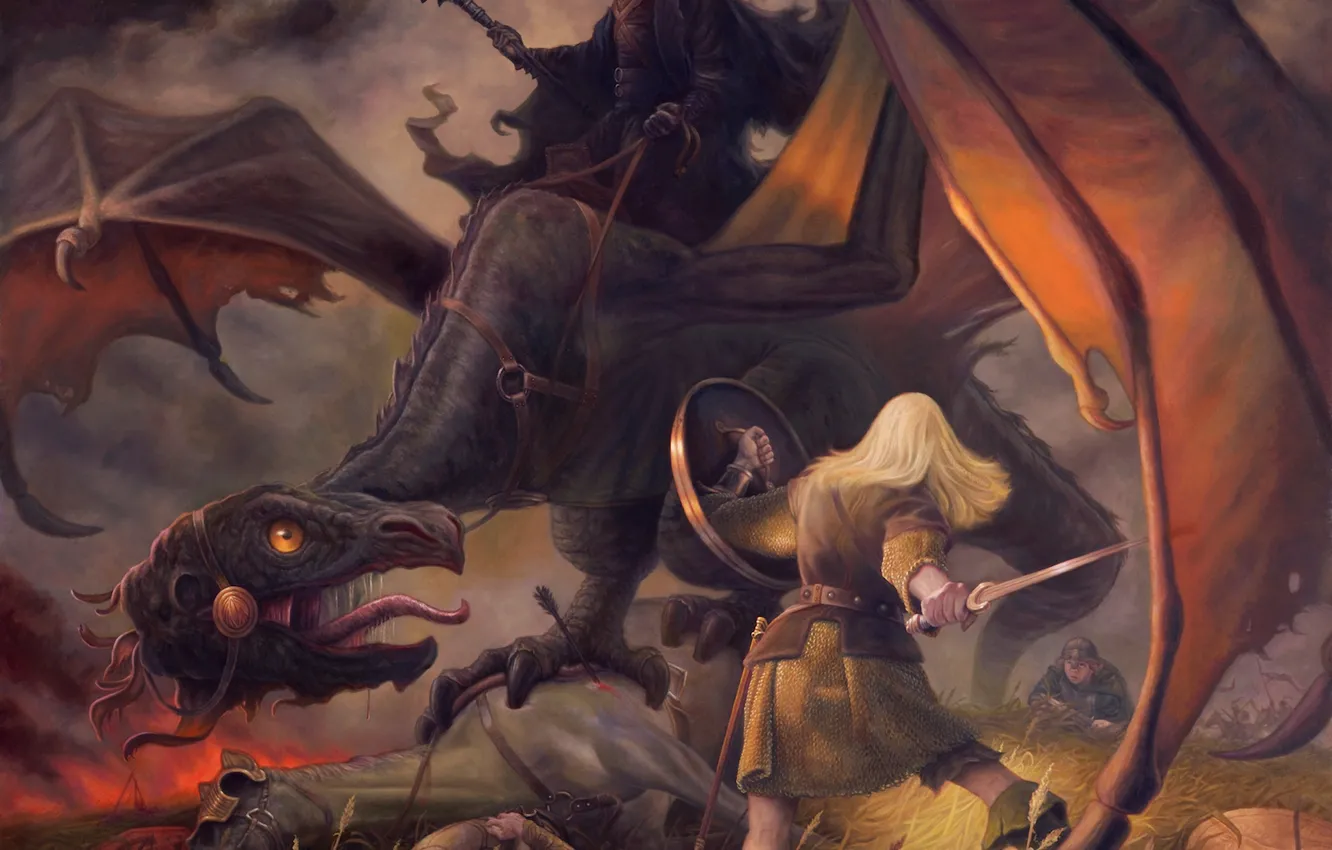
Dernhelm, we all know, is Eowyn.  Sick of being left behind at every turn, she finally goes rogue and disguises herself as a rider.  We understand.

What is more difficult to understand is why she decides to take Merry with her, thus doubling the chances she will be noticed.  She could presumably be an antisocial rider relatively easily, if she's worried talking to other will give herself away.  But hiding a second person is going to be considerably more difficult.  So why does she take Merry, when it makes her own success more doubtful.

Intersectionality is the idea that all social struggle is connected.  That the fight against racism and the fight against antisemitism and the fight against Islamophobia and the fight against sexism are not four separate fights, but four battles for the same fight for social justice.  If those who fight sexism also fight racism, and those who fight racism also fight sexism, each benefit from the cooperation.  It also prevents people from winning 'their' fight and calling it a day.  White women will fight sexism, but black women obviously must fight both sexism and racism.  By intertwining all struggles, all of these fights have more resources.

Eowyn understands intersectionality intuitively.  She is able to wear armor and pass as a man.  Merry, due to his size, will never be able to do that.  He will need some help.  Rather than leave Merry behind, Eowyn ties their fate together by taking him with her.

Intersectionality is like a ladder.  As you fight for your rights, you go up the ladder.  Once up, you use your new elevation to help others climb up.  It calls on me, a white Jew, to use my whiteness to assist Jews who face more antisemitism because they appear more obviously Jewish.  It also demands I use my whiteness to assist other groups, like Muslims and people of color.  It also says that fighting only antisemitism isn't enough.  Resting once antisemitism is defeated (a tall order to be sure) would make me part of the problem.  Of course, the inverse is true: I can depend on Muslims and people of color to stand up to antisemitism with me.  Viewing our struggles as connected makes it harder for others to be pit us each other - no longer may blacks feels Latinx success comes at their expense.  Justice is not a pie - There isn't a finite amount.

Eowyn realizes leaving behind Merry would be unjust.  His struggle is her struggle - he also wants to fight but has been denied.  Eowyn could leave him behind, but why?  If they both go, they can support each other.  If they both go, she won't have to completely isolate herself to avoid being caught.  If she gets Merry's back now, he will have her back later.  The cooperation benefits them both.  Such as it is with social justice.

Another thing to note is to look at Theoden's words more closely, which reflect a privileges and unreflective viewpoint.  He says since "none of my Riders can bear you as a burden," and "what would you do, Master Meriadoc, sword-thain though you be, greater of heart than of stature."  Let's look at these separately.

"None of my Riders can bear you as a burden" makes the assumption that NO ONE wants to bring Merry along.  Theoden supposes that since he considers it too difficult that everyone else will agree with him.  He doesn't consider that other people may disagree and be willing to take on a burden to assist another's cause.  He considers only the cost of bringing him to battle and not the benefit.

That brings us to the other issue, that Theoden considers Merry only a burden.  He admires Merry's energy, but expresses doubt he can really do anything.  Again, Theoden's thinking is very self-centered.  He can't imagine someone different from himself (in both size and training) making an impact on the battlefield.  Theoden's picture of an effective warrior is very narrow.

This narrow thinking suppresses the potential of those around him.  While Theoden thinks he is protecting Eowyn and Merry by not letting them come, this protection is actually a prison.  They may live, but they will not thrive.  It is essential to a fully realized life that one not only survives but flourishes.  But there are many ways to flourish.  In order to help others thrive we need to broaden our sense of what a full life is - otherwise we are only forcing square pegs into circular holes.

Lastly, it's worth noting Eowyn and Merry do in fact make a difference on the battlefield, and they do so precisely because they are not men (Eowyn is a woman, and Merry is a hobbit).  Had they allowed themselves to be left behind Theoden's forces would have been slaughtered.

I will say it again and again: Just because you do not see what someone's potential is does not mean they have none.  In the critical moment, having a diverse array of skills on hand can only increase the chances of success.  But diversity rarely happens on its own.  We must cultivate and encourage it.

The Lord of the Rings: An Ethical Guide is a Patreon-supported project.  Thank you to all those who have contributed.

Like this project?  Want to learn more?  Want exclusive access to behind-the-scenes content?  Go to my Patreon site and see how you can become a part of the action!

Saturday, June 8, 2019

Ruling with Humanity

And [Eowyn] answered: ‘All your words are but to say: you are a woman, and your part is in the house. But when the men have died in battle and honour, you have leave to be burned in the house, for the men will need it no more."
-------------------------------------------------------------------------------------------------

This week we read "The Passing of the Grey Company," which I think is an odd chapter.  The Grey Company is a group of Dúnedain, a specific race of humans of which Aragorn is a part of.  With them are Elladan and Elrohir, Elrond's two sons.  They appear into the narrative without much explanation (They claim to have been summoned, but no one can say by whom), have many conversations with Aragorn that are hidden to us (either because the dialogue is in riddles or 'off-screen') and by the end of the chapter they (with Aragorn and Gimli and Legolas) ride into the mountains to summon a cursed army.

The whole chapter at once gives the feel of a much larger world at play but also is an overwhelming amount of new information in the final book of our series.  Worse yet, we on repeat reads know that these characters don't do much in the rest of the book.  Unlike Denethor, who becomes a central character in the coming chapters, their leader Halbarad appears in the narrative again only to announce Aragorn's arrival in Gondor.  He is later listed among the dead in a battle with Sauron's forces.  As I said, it's odd.

But the Grey Company is not what I wish to discuss this week.  Before Aragorn leaves with them he rides with Theoden back to Edoras, the Rohan capitol, where Eowyn has been dutifully awaiting the return of the men.  She had been charged with protecting the women and children who did not ride out to Helm's Deep.

Aragorn tells her he must leave to go walk the Paths of the Dead.  She says it's dangerous.


‘If you must go, then let me ride in your following. For I am weary of skulking in
the hills, and wish to face peril and battle.’
‘Your duty is with your people,’ he answered.
‘Too often have I heard of duty,’ she cried. ‘But am I not of the House of Eorl, a shieldmaiden
and not a dry-nurse? I have waited on faltering feet long enough. Since they falter no longer, it
seems, may I not now spend my life as I will?’
‘Few may do that with honour,’ he answered. ‘But as for you, lady: did you not accept the charge
to govern the people until their lord’s return? If you had not been chosen, then some marshal or
captain would have been set in the same place, and he could not ride away from his
charge, were he weary of it or no.’
‘Shall I always be chosen?’ she said bitterly.

I've already discussed Tolkien's sexism at length.  But here we see something a little different.  Aragorn, usually the text's voice of reason, is entirely unhelpful.  Rather than listen to Eowyn's particular needs, he appeals to general expectations.  Eowyn, as a woman, is expected to care for the people.  Sure, Eowyn doesn't want this life, but who gets to spend their life as they like anyway?  And anyway, if you won't do this, someone else will, and then they are the ones stuck.  It is worth noting his hypothetical 'marshal or captain' is a male.  Aragorn seems to imply it is worse for a man to be trapped by duty than a woman.

Eowyn, as highlighted at the top, is pushed to the breaking point.  She sees her duty as a barrier to what she really wants, which is to join the men in battle.  Her duty will keep her inside, and the best she can hope for is when the war is over and she is burned to death in the house.  That's the closest she can hope to getting a warrior's funeral pyre.

We modern people understand Eowyn's frustration quite easily.  While she gets shut down very directly (Which seems like the text is repudiating feminism), it is of course worth noting Tolkien could have had her personality align with her duty, thus preventing this conflict entirely.  So at least he gives feminism a voice, even if it is defeated.

Empathizing with Eowyn here is easy.  So let's look at things from Aragorn's point of view.  He's just had a group of kinsmen show up and tell him he must walk the Paths of the Dead.  When they arrive, Elrohir says:

‘I bring word to you from my father: The days are short.
If thou art in haste, remember the Paths of the Dead.’
‘Always my days have seemed to me too short to achieve my desire,’
answered Aragorn. ‘But great indeed will be my haste ere I take that road.’


Aragorn does not want to take the Paths of the Dead.  However, he must.  The Dúnedain have come both to tell him the time has come and ensure that he does it.  Aragorn is compelled by the duty of his birth, for only a descendant of the kings of Gondor can summon the cursed army.

Aragorn is wracked with grief by this duty.  He is in no mood to compromise.  When Eowyn confronts him, he holds her to the same standard he holds himself.  This seems noble, if unkind.  Double standards are indeed unfair, and one destined to be king must be fair.  We can excuse Aragorn's obstinance, given his position.

We can, but we should not.  Rules do not enforce themselves.  They should be interpreted, and occasionally bent.  Aragorn is destined to be king.  With great power comes great responsibility.  Eowyn is the niece to a lesser king.  There's no reason Eowyn's duty should be as binding as Aragorn, especially as someone else could do it.  As Aragorn said, if Eowyn did not stay behind, someone else would need to.  But if Aragorn shirks his duty, there is no one else.  Their situations are unalike, and they should be treated that way.

It is easy to enforce rules with a single standard.  You either meet expectations, or you do not.  It is more challenging to enforce rules with nuance.  Sure, everyone should keep their noise level relatively low during a plane ride, but you should react differently to a teenager being too loud than an infant being too loud than an adult being too loud.  Just because you're able to get up in the morning and exercise doesn't mean everyone else who doesn't is simply choosing not to.  People are different.

Understanding and accounting for these differences improves our rules, rather than degrades them.  Mercy strengthens justice by saying those do receive harsh judgments deserve them.  Rules do not enforce themselves, nor do they exist by themselves.  They are created by us to support the kind of community we want to live in.  If we let our rules dictate our community, we have lost sight as to why they were made in the first place.

Sometimes, we must be willing to bend the rules.  Occasionally, we need to replace them entirely.  Community is not a static thing.  Rules should not be, either.  Otherwise, they become a prison of the past.

The Lord of the Rings: An Ethical Guide is a Patreon-supported project.  Thank you to all those who have contributed.

Like this project?  Want to learn more?  Want exclusive access to behind-the-scenes content?  Go to my Patreon site and see how you can become a part of the action!
Sunday, June 2, 2019

What's in a Helmet?

This week we read "Minas Tirith."  Minas Tirith is the capital of Gondor, the seat of the throne and the home of Denethor, Boromir's father.  Gandalf and Pippin arrive here having left Isengard previously.  When they arrive, Pippin is questioned by one and all - they've never seen a hobbit, what they call a halfling.  Pippin quickly becomes famous around the city.

When they arrive, Gandalf and Pippin first go to see Denethor.  Denethor is the Steward of Gondor - his job is to lead Gondor until the king returns.  This is the first chapter of "The Return of the King."  You don't need to have read the other two volumes to know that Denethor's time is at an end.  As we will see, he is unhappy about it.

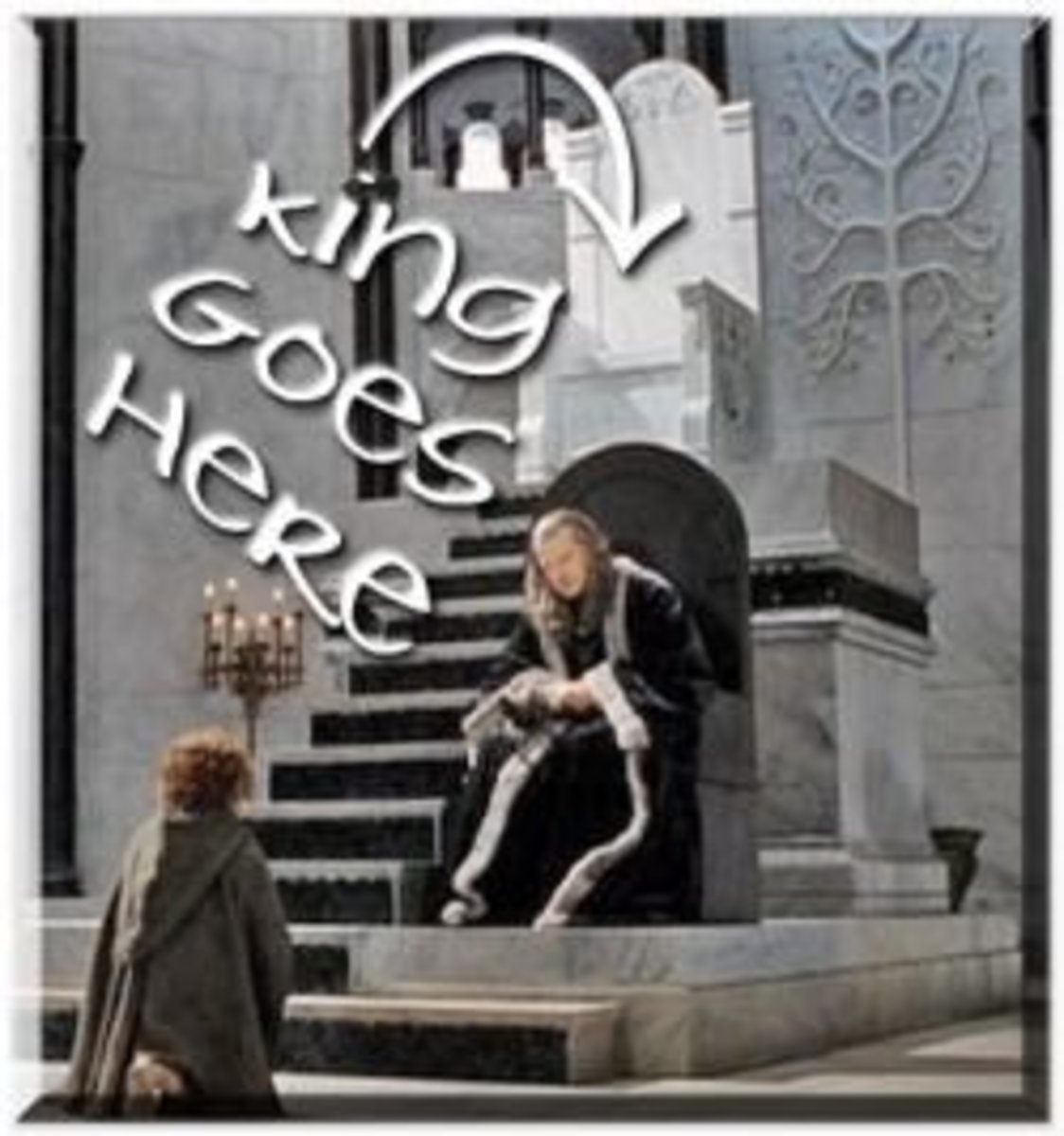
Before entering the throne room (Where Denethor sits, somewhat comically, next to the throne), they pass through a courtyard.  This courtyard is home to the White Tree, which holds great symbolic value to Gondor, though we have not dealt with it much in our story.  For such a special place, special guards and garments are appointed.  We are told:

The Guards of the gate were robed in black, and their helms were of strange shape,
high-crowned, with long cheek-guards close-fitting to the face, and above the cheek-guards were set
the white wings of sea-birds; but the helms gleamed with a flame of silver, for they were
indeed wrought of mithril, heirlooms from the glory of old days. Upon the black surcoats were embroidered
in white a tree blossoming like snow beneath a silver crown and many-pointed stars. This was the livery of
 the heirs of Elendil, and none wore it now in all Gondor, save the Guards of the Citadel before the Court of
the Fountain where the White Tree once had grown.


What can we learn anything from analyzing these outfits?

The armor hearkens constantly back to former days, which the characters view as noble (though, as we've seen on closer analysis, this is not the only reading of the text).  The sea-birds wings recall both the island of Numenor (from which many of the most noble of Gondor are trace their lineange) and The Undying Lands over the sea, where the Elves, the best of all the races of Middle Earth, are destined to live forever.  We are told the helmet is made of mithril, a mineral mined and made into armor by Dwarves.  So already we have a connection to the three major races of Middle Earth.

On their chest is the White Tree, another connection to Numenor.  White Trees (I don't know if they can be pluralized like that...) do not grow naturally in Gondor.  The White Tree  is from Numenor - a sapling of it was brought when that realm fell.  A new White Tree was planted in the courtyard of Minas Tirith.  However, that tree died.  No new sapling has yet been found, so the decision has been made to guard the dead tree, since it represents such an important connection.  Hence why the passage ends "where the White Tree once had grown" but not "where the White Tree once had stood."  The White Tree does not grow any more, but it still remains.

And so we have this armor whose decorations mostly represents the past.  What of it?

The past is what drives us.  Whether our personal past, or an understanding of what has happened to others (Sometimes this is called "history"), it is impossible to make an informed decision without a past to reflect on.  Those who don't know the past are doomed to repeat it, yada yada.  Only by knowing the past can we improve our future.

Of course, the past can only do so much.  I said the past drives us, but maybe it's better to say the past informs us.  After all, we're the driver.  And we drive forward, not back.  In this sense, I think the tradition of Minas Tirith respects the past too much.  I mean, they guard a dead tree from a destroyed realm.  They are not guarding something that can provide for them, but instead only setting watch to its inevitable decay.  At a certain point, the past must be left behind.  You can learn its lessons without dragging it wholesale everywhere you go.

I asked at the top of the post "What's in a Helmet?" On the one hand, the answer is: The parts of your life and history you choose to highlight.  Gondor chooses Numenor and the connection between Humans, Dwarves, and Elves.  But, really, what's in a helmet?  The answer is you.  Your head.  What gives you strength and inspires you to greatness is less important than the follow through.  The future is bright and uncertain and unmolded.  Go make it your own!

The Lord of the Rings: An Ethical Guide is a Patreon-supported project.  Thank you to all those who have contributed.

Like this project?  Want to learn more?  Want exclusive access to behind-the-scenes content?  Go to my Patreon site and see how you can become a part of the action!
Saturday, May 25, 2019

A Dark Ending

Like most second parts in a trilogy, The Two Towers tells a dark story.  Helm's Deep is a squeaker of a victory.  Many lives were lost in the defense of Helm's Deep, and defeating Saruman gets them little closer to Sauron.  The only thing they really gain is the palintir, which so far has caused only trouble.

On the other side of the Anduin, Frodo and Sam find in Gollum a guide to Mordor whom they know they cannot fully trust.  We meet Faramir, who fights what he considers a hopeless war.  The book ends with Gollum finally betraying Frodo and Sam in the darkest of places.

The final chapter of this book is called "The Choices of Master Samwise".  Assuming Frodo is dead, Sam realizes the duty falls to him to take the Ring to Mount Doom.  He takes the Ring and starts to leave Frodo behind.  But then he hears orcs come to take Frodo's body, and Sam cannot help but return to Frodo.

Realizing there are too many orcs to fight, Sam listens.  Frodo is not dead, as Sam had thought.  Shelob's poison merely knocked him out.  The orcs take Frodo's body, and Sam secretly follows behind.   Finally the orcs leave the tunnel and go into a tower, the door of which shuts behind them before Sam can get in.  The chapter ends like this:

The gate was shut. Sam hurled himself against the bolted brazen

plates and fell senseless to the ground. He was out in the darkness.
Frodo was alive but taken by the Enemy.

Frodo has been captured.  Sam has the Ring but has given up the Quest to find Frodo, and then he ran into a door so hard he knocked himself out.  Eat your heart out, Empire Strikes Back.


Uncertainty over Frodo's fate will hang over the first half of our next book.  Though the other characters will do what they can against Sauron, Frodo is the key to victory.  Truly, all they can do is hope.

We're living through dark times.  Women's rights are being subverted by the 'rights' of fetuses.  The Executive Branch is refusing to comply with the Legislative Branch's attempts at oversight.  Climate Change is coming - or maybe it's already here.  It's hard to keep track of it all and also hard to keep it from feeling personal.

A good thing to recall is that we are not the Frodo of this story.  Not everything depends on us.  We can worry and provide support but we don't have to surrender our whole life to the cause.  We can also have our own lives.  We should do what we can, but we should also find time to enjoy life.

We may be in darkness now.  We may be living through an extended period of political and humanitarian darkness.  Such may be our fate.  Here's a quote from much earlier in our text - Chapter 2 of Fellowship:

“I wish it need not have happened in my time," said Frodo. "So do I," said Gandalf,
"and so do all who live to see such times. But that is not for them to decide.
All we have to decide is what to do with the time that is given us.” 

It may be our doom to endure this darkness, but let's look at it this way: The burden is ours. If we can overcome it, future generations will be spared.   Not that a martyr complex is good - such a view of self-sacrifice can cause one to be ready to give up everything.  But if we are willing to live hard lives, if we are able to find sustaining pleasures in those lives, we may have the grit to give those who come after us better lives.  And maybe they will remember our sacrifices, maybe they won't.

I feel as if I am stumbling again over the same theme that caused me difficulty a few weeks back.  The issue boils down to "What are the ethics of hopelessness."  One cannot counsel hope.  Recommending that one pretends everything is fine is also impractical.  But dwelling on one's hopelessness is also a bad recommendation - it saps one of all motivation.  What do we do with such a dangerous state of mind?

A reorientation is in order.  For the next book, in addition to finding a theme or lesson in each chapter, I will also excerpt a passage related to hopelessness to see what the text says.  Maybe the Creative Wizard has left us clues that way.  Maybe not.  We'll see - I really don't know what I'll find.  The future is uncertain.

And that's where we'll end.  The future may not be hopeful, but it is uncertain.  We should remain vigilant and look for new opportunities as the situation changes.  Whether large opportunities like victory at the supreme court and at the border, or smaller opportunities like providing a safe space for someone when they are overwhelmed, we should act when we can.  We're in dark times now, but unlike our text, this is not the end for us.


The Lord of the Rings: An Ethical Guide is a Patreon-supported project.  Thank you to all those who have contributed.


Like this project?  Want to learn more?  Want exclusive access to behind-the-scenes content?  Go to my Patreon site and see how you can become a part of the action!
Saturday, May 18, 2019

To Guide or to Ensnare

This week we read "Shelob's Lair."  Gollum's plot comes to fruition as he brings Sam and Frodo to the lair of Shelob, an ancient evil in the form of a spider.  Though Shelob lives on the border of Mordor, she is not a creature of Sauron.  The text says, "How Shelob came there, flying from ruin, no tale tells, for out of the Dark Years few tales have come. But still she was there, who was there before Sauron, and before the first stone of Barad-dûr; and she served none but herself, drinking the blood of Elves and Men, bloated and grown fat with endless brooding on her feasts, weaving webs of shadow; for all living things were her food, and her vomit darkness."  Shelob evokes the dark side of the Elder days for which the Elves are so nostalgic.  Not all had been well.

That the text tells us Shelob vomits darkness is curious, to say the least.  How can darkness be vomited?  What is the difference between darkness vomited by an ancient evil and, you know, regular darkness.  Well, as luck may have it, the text tells us.  When Sam and Frodo enter her lair...

In a few steps they were in utter and impenetrable dark. Not since
the lightless passages of Moria had Frodo or Sam known such
darkness, and if possible here it was deeper and denser.
There, there were airs moving, and echoes, and sense of space.
Here the air was still, stagnant, heavy, and sound fell dead.

This darkness is more intense. Moria was created for whole clans of Dwarves to live and work in. Shelob's lair was created for her alone. It is unwelcoming and it's selfishness fills the space. Perhaps that is why she and Gollum get along so well. The text flashes back to some old muttering of Gollum after he had come up with his plan: "O yes, it may well be that when She throws away the bones and the empty garments, we shall find it, we shall get it, the Precious, a reward for poor Sméagol who brings nice food." They both have selfish reasons for wanting Sam and Frodo dead. Shelob vomits darkness precisely because she wants her lair to be uninviting. She's only concerned with her own sustenance.

This leads us to another distinction between the darkness of Shelob's lair and the darkness of Moria.  In Moria, they had guides, both Gandalf and Gimli.  Gandalf, by far the wisest of all the Fellowship, had brought them into Moria with the intention to get them out.  Gimli, meanwhile, is able to act like tour guide.  Gandalf will see them through Moria and Gimli will ensure their stay is informed.

But in Shelob's lair, the only other two are Gollum and Shelob, herself.  Gollum brought them into her lair, but with the intention of trapping them.  Shelob, meanwhile, will use her knowledge of the space to ensnare, not inform.

In our world, there is a lot of darkness.  But I think the one best compared to underground caves is the self.  There are many parts of ourselves we are unfamiliar with, or that we keep hidden.  When we explore them, we must be prepared - otherwise, we will be overwhelmed.

Exploring ourselves with a therapists is like entering Moria.  The purpose is to go in and then out, and notice things along the way.  Then you take what knowledge you found and apply it to the rest of your life.

But there are ways to enter yourself like it's Shelob's lair, a place meant to entrap you.  Instead of a wizardlike therapist, you'd have a gollumlike trickster.  They will lead you down into yourself and use your tendencies and habits against you to get what they want, without considering the cost to you.

"Know thyself" is a very old adage, and one I think is very good (Though here is an opposing opinion I came across).  You should know your strengths and your preferences and seek out a life that complements those.  You should also know your weaknesses and what you dislike, and attempt to minimize their intrusion into your life, or at least learn coping mechanisms for them.  There's more to oneself than likes/dislikes and strengths/weaknesses, but let's leave it there for now.

Knowing yourself is a way to defend yourself from becoming trapped in your own Shelob's lair.  It allows you to see the patterns in your behavior, and will help you break those patterns when someone is using them against you.  Had Gollum led Sam and Frodo into Moria, they would not have been ensnared so easily.

I play a board game called Diplomacy pretty competitively.  The game calls for strategic thinking.  However, I sometimes get distracted by interesting ideas that, long-term, are not actually good.  This would get used against me in games - people would point out interesting ideas and let my excitement do the rest in pulling me off course.  Over the years, with effort, I've learned to curtail that tendency.  On particular occasions, I can even feign excitement so they think they got m" but really I maintain the upper hand.  In this way I have taken what had been a Shelob's lair for me and turned it into a Moria - a place I am quite familiar with.

I recently heard a Buddhist teaching that one should increase the space between a stimulus and your reaction.  There's nothing wrong with getting mad at someone, but if you can feel mad, stew it over in your mind for even a few seconds, and then express your anger, you're far more in control than if you respond immediately.  An immediate response is more likely to lead you into Shelob's lair.  If someone knows you are easily provoked, your anger can be used against you.  But if you can maintain control, you will not be so easily ensnared.


The Lord of the Rings: An Ethical Guide is a Patreon-supported project.  Thank you to all those who have contributed.


Like this project?  Want to learn more?  Want exclusive access to behind-the-scenes content?  Go to my Patreon site and see how you can become a part of the action!

Sunday, May 12, 2019

Holding to a Purpose

When does worry turn to pessimism turn to despair?  There's so much in the world to fret over, it is essentially never-ending.  Not matter who you are, you will struggle regularly in life.  Whether you're poor and struggle to find your next meal, or you're not-as-poor and live paycheck to paycheck from a job you don't like for that meal, or you're wealthy and thought money would bring you peace but you still feel restless and unfulfilled.  Whether you're in a collapsing relationship, a collapsing house, or on a collapsing planet, there's plenty to be anxious about.  What does our text say about this?

This week we have another double portion -  "Journey to the crossroads" and "The Stairs of Cirith Ungol."  Frodo and Sam and Gollum leave Faramir's rangers and enter Mordor.  The darkest part of their journey begins, and there's little hope of success.  Frodo worries they've delayed too long and that while they may complete the Quest the others from their fellowship may already be dead.  What good is victory then?

Amidst this gloomy atmosphere, we get an interesting scene of hope.  The text says:

The Sun was sinking, finding at last the hem of the great slow-rolling pall of cloud, and falling in an ominous fire towards the yet unsullied Sea. The brief glow fell upon a huge sitting figure, still and solemn as the great stone kings of Argonath. The years had gnawed it, and violent hands had maimed it. Its head was gone, and in its place was set in mockery a round rough-hewn stone, rudely painted by savage hands in the likeness of a grinning face with one large red eye in the midst of
its forehead. Upon its knees and mighty chair, and all about the pedestal, were idle scrawls mixed with the foul symbols
that the maggot-folk of Mordor used.

Suddenly, caught by the level beams, Frodo saw the old king's head: it was lying rolled away by the
roadside. `Look, Sam!' he cried, startled into speech. `Look! The king has got a crown again!'

The eyes were hollow and the carven beard was broken, but about the high stern forehead there was a coronal of
silver and gold. A trailing plant with flowers like small white stars had bound itself across the brows as if in reverence
for the fallen king, and in the crevices of his stony hair yellow stonecrop gleamed.

'They cannot conquer for ever!' said Frodo. And then suddenly the brief glimpse was gone. The Sun dipped
and vanished, and as if at the shuttering of a lamp, black night fell.

Though I usually try to avoid referencing the movies, in typical "A picture is worth a thousand words" fashion, here's how they showed this moment in the movies.

'They cannot conquer for ever' Frodo says.  This is comforting in an abstract, kind of martyrdom way.  Frodo, who was regarded his mission as suicidal since the Fellowship dissolved, finds relief in it.  His Quest may fail, or it may be futile  for those he knows, but good will eventually win out.

But this advice isn't very useful to us.  Children died during World War I, and while the Central Powers were defeated, what comfort is that for them or their family?  The Korean War has allowed South Korea to be a successful society in stark opposition to the North's fate.  But what about for those Koreans, Chinese, Americans and even far-flung Australians who died?  What do they get?

Life can stink.  I hope it doesn't for you.  But parts of it may well.  People's fears and dangers are rooted in all sorts of things - politics, society, money, identity, sports, whatever.  And sure, "they cannot conquer forever", but if you didn't live to see the Red Sox finally win the World Series in 2004, you likely went to your grave cursing Bill Buckner.  We don't need to be conquered forever - we only need to be conquered during our lifetime.  And sometimes we are.

Climate change is coming, but our demise is not the end.  The Earth will endure, as it has before we turned up.  But that's a nihilistic point of view - to say things are bigger than ourselves and therefore we shouldn't really care because "they", whoever they are, cannot conquer forever.  That cannot be a healthy point of view.  It allows one to endure all sorts of suffering with little chance of seeing a turn of fortune.  Ultimately, it's misplaced faith.  

So what should we have faith in?  Our small selves?  Our impersonal institutions?  Those we love, who are also small?  The ideals we reach toward, which are also impersonal?  It's difficult to say.  It is possible for all those things to fail.

Recall that Frodo had despaired that everyone he knew might already be dead.  When this thought hits him he collapses in tears.  But then:

Frodo raised his head, and then stood up. Despair had not left him, but the weakness had passed.
He even smiled grimly, feeling now as clearly as a moment before he had felt the opposite,
that what he had to do, he had to do, if he could, and that whether Faramir or Aragorn or Elrond
or Galadriel or Gandalf or anyone else ever knew about it was beside the purpose...

This is not the first time we have seen Frodo turn despair into resolve, but that is a difficult lesson to apply to our lives.  Hopefully we do not, amidst our difficulties, find ourselves truly despairing.  But the key phrase here I want to hone in on is "Despair had not left him."  Frodo manages to focus on what must be done to alleviate his despair, rather than focusing on the despair itself.  He does not let the despair control him.  If you ever find yourself in a desperate situation, I hope you will do the same.  "If you're going through hell, keep going."


The Lord of the Rings: An Ethical Guide is a Patreon-supported project.  Thank you to all those who have contributed.

Like this project?  Want to learn more?  Want exclusive access to behind-the-scenes content?  Go to my Patreon site and see how you can become a part of the action!

Saturday, May 4, 2019

When To Doubt

This week we read "The Forbidden Pool," which takes place in the middle of the night.  Frodo is roused by Faramir, who tells him to come with him to see something. Sam,"waking suddenly by some instinct of watchfulness," follows them both.  They go to the edge of the hideout and Faramir points out a creature in the pool underneath - it is Gollum!

Faramir asks Frodo what he should do.  Gollum has found their secret hideout.  He can lead all sorts of enemies to it.  He must die before that.  What should Faramir do?

Frodo did not answer for a moment. Then `No! ' he said. `No! I beg you
not to.' If Sam had dared, he would have said `Yes,' quicker and louder. He could not
see, but he guessed well enough from their words what they were looking at.

Hesitation is usually seen as a weakness.  Decisive action is more praiseworthy.  Hesitation reveals doubt and can be seen as a lack of conviction.  Sometimes it is.  If you hear someone use an offensive slur and need 24 hours before you call it out people will wonder why you didn't call it out immediately.  On the other hand, if you are told someone's boss was abusively criticizing them during a meeting but when you accuse the boss they can prove they weren't working that day, you will be criticized for acting too swiftly.

Hesitation is the result of doubt.  Doubt is when we are unsure.  It will surprise few of you to learn I am a proponent of doubt - I would prefer to hesitate when I should have acted than acted when I should have hesitated.  In the examples above, it is possible to explain why one hesitates even when the wrong is obvious.  False accusations are much more difficult to take back.

But doubt is more than being unsure.  Doubt reflects a larger thought process.  Let's get back to the text.

Why is Sam so eager to let Gollum die?  Because he is looking out for Frodo, and Sam thinks Gollum is a danger to him.  Sam wants to protect his friend and master (Though usually portrayed as very good friends, and they are, ultimate Sam's relationship to Frodo is better explained as a loyal servant than a close friend).

Frodo knows the danger Gollum poses.  But Frodo also has the Quest in mind.  Gollum is their only hope of getting inside Mordor.  No matter the danger to himself, if Gollum dies the Quest will fail.  And Sauron is much more dangerous than Gollum.

Frodo hesitates to consider his options.  But when he answers he answers firmly.  He says no twice, then says "I beg you not to."  Frodo hesitates in his thought, but his action is decisive nonetheless.  His waffling is internal, only.

And yet we shouldn't look too harshly on Sam.  The Creative Wizard tells us he would have spoken only "If Sam had dared...".  But he did not.  What stopped him?  Sam knows Frodo is thorough and that Frodo has the Quest on his mind.  Here, Sam also showcases a larger thought process.  Though he has a preference, he puts his loyalty to Frodo first.

I am putting together next year's youth board for the synagogue I work at.  All the teens who are interested need to fill out an application.  This application asks, among other things, what role they tend to take on in group situations.  Because they are applying to be community leaders, nearly all of them said they are leaders in groups.  This presents a problem.  Have you ever been in a place where everyone thinks they are the smartest in the room?  That many egos in one place can get messy.  And teen egos can be much harder to rein in.

The teens, in order to be a successful leadership board, will each need to learn hesitation.  They'll need to learn doubt and patience.  They will need to learn how to widen their thinking and how to shrink their own presence in order to let others have space to shine.  Collaboration demands space for coexistence.  When people have different ideas, doubt is the foundation of the solution - surety will only inflame it.

Frodo showed doubt at the right moment.  He had the opportunity to have Gollum killed, and yet he knew that ultimately betrayed his own goal.  Sam had the opportunity to speak up, but that would have betrayed his loyalty to Frodo - even if his goal was to protect him.  And let's not forget Faramir, who is guarding his secret hideout, and could have killed Gollum without a word to the hobbits.  But something stops him.  We never know what.  But isn't that always the way?  Who can really tell what doubt is - what it feels like in our gut.  But we know it when we feel it, and we would always do well to examine it.


The Lord of the Rings: An Ethical Guide is a Patreon-supported project. Thank you to all those who have contributed.

Like this project? Want to learn more? Want exclusive access to behind-the-scenes content? Go to my Patreon site and see how you can become a part of the action!