Search This Blog

Saturday, February 16, 2019

The Art of Persuasion

This week is another double portion, and so we read two chapters instead of one.  This week we read "The Uruk-Hai" and "Treebeard".  The titles offer a good contrast of content.  The Uruk-hai are a new form of orc created by Saruman, while Treebeard is an ent, a race that is new to us but among the oldest on Middle Earth.  It is a recurring theme in our text that new is bad and old is good.  Accordingly, the uruk-hai are evil and the ents are good.  

In our first chapter we rendezvous with Merry and Pippin as they are carried off toward Isengard.  Our text has backed up a few days in time.  We hear the orcs worry about the horsemen who are chasing them, and gaining on them (They evidently do not notice the three hunters also in pursuit).  They flee for what seems to be a whole 24 hours, finally resting out of necessity.

While they are resting, conflict boils over among the orcs and Merry and Pippin seize the opportunity to escape.  By the time the Rohirrim have destroyed the orcs, Merry and Pippin have escaped into nearby Fangorn Forest.

The second chapter follows Merry and Pippin through Fanghorn, a forest like the Old Forest, if maybe a little less oppressive.  They eventually meet Treebeard, an ent, who - after hearing their news that Gandalf has fallen and that Saruman and Sauron are working together - calls a meeting of his kind: an entmoot.  At the end of this meeting, Treebeard announces the ents have decided to attack Isengard to punish Saruman.

Let's go back to the first chapter.  As the conflict between the orcs is escalating, Pippin finds himself face to face with an orc who keeps pawing at him.  We are let into Pippin's thoughts:

'Grishnákh knows about the Ring!  He's looking for it...
he probably wants it for himself.'  Cold fear was in
Pippin's heart, yet at the same time he was wondering
what use he could made of Grishnákh's desire."

Pippin convinces Grishnákh to take he and Merry away from the other orcs, so that he can take the Ring without anyone else noticing.  Then Pippin says it is hidden away and that he himself will give it to him, if only he'd cut the ropes tying his hands.  Grishnákh does this and then, fortunately, the Rohirrim arrive and he gets runs him down.  Merry and Pippin, now untied and unguarded, are able to escape.

When trying to convince someone to do something, we often mistake the ends and the means.  We want to hang out with them, we assume we must make them want them to hang out with us.  We want our family to use their screens less when we're together, then we must convince them what we know is true: screens are bad.  But this is not an effective way to convince someone - it assumes they think like us.  The trouble is other people think differently than we do.  In order to change their minds we must change our own thinking, first.

We say we live in a post-fact world, but I think we regularly overestimate the power of facts in convincing someone.  The primary way to convince someone is not to throw facts at them.  They likely have their own facts - or their own "facts".  Further, they likely are a part of a community that cherishes those talking points, false or not.  If I were suddenly convinced of a flat earth, the relationship I have with my friends and community would change dramatically.  I'd either need to find new ones or hide a piece of myself from them.

A better way to convince someone is to find what they value and connect it to your talking points - not to use talking points to try to alter their values.  An excellent example is abortion.

(There are of course many more nuances to the abortion debate.  For simplicity's sake I am only discussing voluntary abortions during a pregnancy that does not endanger the life of the mother)

For those who are pro-life, those who are pro-choice seem to disregard inconvenient lives.  They see the fetus as a life, and since all lives are equal, how can someone justify prioritizing the woman's want over the fetuses existence?  You had sex, there's a consequence.  Being able to ignore unpleasant consequences can cause one to be morally reckless.  Abortion is a symptom of a selfish society.  And since pro-lifers view abortion as murder, it is the quintessential symptom of a selfish society.

Those who are pro-choice think those who are pro-life are trying to keep women controlled, and that they think a women's reproductive capacities should be her primary potential.  It's about individual autonomy - which a fetus lacks.  Pro-choicers see women who choose to have abortions as women making a personal decision about their own body and their own life.  An autonomous person should not be forced to give up their autonomy for the sake of something non-autonomous.  We finally have the technology to help women decide when to have children.  Forcing women to bear children they don't want when we can prevent it seems socially backwards.

Debates between these two sides is rarely productive.  One side shouts about the value of the life of the fetus, and the other about the value of the autonomy of the woman.  There is little overlap.  It becomes an argument of which value to prioritize.

For the record, I am pro-choice.  So how would I apply this to trying to convince a pro-lifer?  They value life, so I'd begin there, applying that value to the woman.  What would be a better life, that the woman be forced to give birth when she doesn't want to, costing her time and money she won't get back, or letting that woman build a strong personal foundation, giving her a full life, and then letting her choose when/if to bring a child into the world - a child she will be ready and excited for, rather than one she may resent for derailing her life's plan.

This argument may remain unconvincing, but it at least tackles the issue they are talking about.  They want the child to live, so talk about the life of the mother.  Life is more about being alive, it is about being happy and fulfilled.  They want the child to live, so talk about the life of children born into families prepared and ready versus the life of unwanted children.  At least this makes the conversation potentially productive.

Similarly, Pippin is able to use Grishnákh's values for his own gain.  Grishnákh is greedy and is worried the other orcs won't share the credit of delivering the hobbits to Saruman.  Pippin promises him a way to profit immediately, and through this ruse is able to escape.  While we can say Pippin was lucky the Rohirrim came when they did, I think it's better to say Pippin put himself in a better position than he had been before.  It's possible, had the riders attacked a little bit later, that Grishnákh would have realized Pippin was lying and killed him out of frustration.  But if he had stayed in the orc camp he certainly would have been killed, luck or no.  We know that Éomer said they strove to leave none alive.  Sometimes progress is putting yourself in merely a better position than before.

People's values are notoriously difficult to change - and for good reason.  Is it really a 'value' if you can easily be talked out of it?  If you want to convince someone then you should learn their values and find a way to connect your talking points to those values.  Persuasion is not an act of brute force, but rather a guided tour.  Instead of Tetris, where you throw down as many blocks as you can, it's Jenga, where you need to analyze the situation to determine the best block to use.  And, like Jenga, when done correctly, discussions build everyone up.

The analogy works again in another way.  Did you check out that Jenga game up above?  It's awful.  Jenga is not a game to be played online - it should be played in person.  Similarly, while sometimes we can engage in meaningful conversations online, persuading someone else is easier in person.  You can see facial expressions, tone of voice, etc.  All of these are important ways to see if you're getting to someone, which will help you know which arguments to follow and which to abandon.


The Lord of the Rings: An Ethical Guide is a Patreon-supported project.  Thank you to all those who have contributed.

Like this project?  Want to learn more?  Want exclusive access to behind-the-scenes content?  Go to my Patreon site and see how you can become a part of the action!


Saturday, February 9, 2019

Breaking News Norms

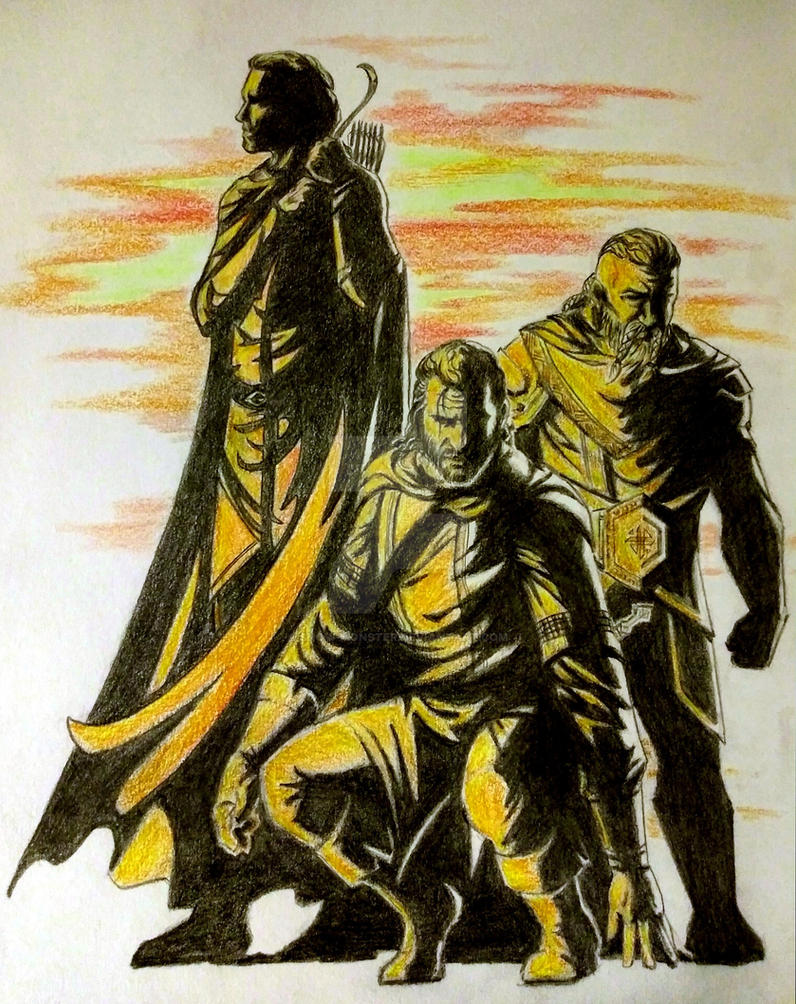
This week's chapter is called "The Rider's of Rohan."  Aragon, Legolas and Gimli follow the trail of the orcs who captured Merry and Pippin for many miles, eventually leading them to Rohan.  We've heard of this realm before, but know little of it.  Perhaps suspiciously, none from Rohan were present at the Council of Elrond.  They do not know of the Quest.

While following the trail, the three hunters are surprised to see a large group of horsemen coming directly towards them - away from the orcs.  Are they fleeing?  Are they following orders?  Our text tells us that Aragorn says, "We will wait... We may get news from them."  Gimli responds by saying, "Or spears."  Aragorn speaks again, "I did not say that we should hear good news.  But evil or good we will await it here."

The horsemen reach them and we meet their leader, Eomer.  Eomer is a man of Rohan, the King's nephew.  Aragorn actually knew his father, Eomund.  ("Eo" is an important phoneme in Rohirric, the language of the people of Rohan).  Though there is much initial distrust, and even threats of violence, they eventually untangle their differences and realize they are on the same side.

Eomer does not have any news about the fate of Merry and Pippin.  He says they attacked the orcs and destroyed them, leaving none alive.  But of course, the battle was chaotic and Eomer only has one set of eyes.  He admits its possible some escaped, Orc or otherwise.  Aragorn and Legolas and Gimli take their leave of Eomer who asks them to go to Edoras, King's seat in Rohan, when they are done looking for their friends.

This week I want to take a closer look at what Aragorn said to Gimli.

"I did not say that we should hear good news.  But evil or good we will await it here."

In January there was an episode at the Capitol between a group of Black Hebrew Israelites, a mostly white group of students and chaperones from a Catholic high school, and a lone Omaha Nation Elder who is also a US Military Veteran.  We all know the story, and the story about the story.  It was a mess, and it seems impossible to not be outraged, no matter your point of view.  And outrage sells and drives shares.  It is to the benefit of social media companies and news organizations.

Nevermind that the story kept changing and that new videos were released.  Everyone on my social media (myself included) felt the need to get a word in.  Silence can be interpreted as complicity, and we all want to avoid the wrath of the online mob.

But as new information came out, people were finding themselves backtracking.  Oh, the Omaha Elder walked into the crowd, they did not walk and surround him.  Oh, the students were waiting for a school bus to pick them up when the Black Hebrew Israelites began yelling at them.  Someone did indeed use a racial slur - but it was the Black Hebrew Israelites who called a student who was black the N word.  And what about that damn smile?  Is he being arrogant or calm or simply frozen in an overwhelming moment?

It was dizzying.

This is not the first time media has jumped to the wrong conclusions in an effort to be first.  When Obamacare was first challenged in the Supreme Court, both CNN and Fox wrongly reported the law had been struck down.  This was based on what they read at the beginning of the decision.  They ran the headline and figured they'd fill in the details later.   Everyone wants to be the first news organization to publish a story.  No one wants to get scooped.  But CNN and Fox, essentially, scooped themselves...

The problem now is with social media, everyone feels the pressure CNN and Fox felt.  We all want our opinions heard, and we want people to know we are up to date.  Hell, I have some social media connections whom I view as legitimate news sources.  I shouldn't, but they have shown themselves to be reliable and thoughtful, time and time again.  But this pressure probably adds to the trouble.  They have shown themselves to be both fast and reliable, and they will want to maintain that reputation.  Inevitably, mistakes will happen.

And while news organizations can offer corrections, it is much harder for people on social media to.  "Yeah ok maybe those kids weren't chanting 'build the wall' but doesn't it seem like they could have been?"  Traditional media has a long tradition of "we regret the error."  Social media does not.  Being wrong online isn't just a momentary error.  It's deemed a personal failure.

Currently the breaking news stories are about Liam Neeson and Virginia's top state officials.  Liam Neeson admitted he spent about a week and a half hoping to avenge his friend's rape by a black man by attacking another black man.  In Virginia, The GovernorLieutenant Governor, and Attorney General are each caught up in their own scandal.  All of what these four men are accused of / have confessed to range from bad to terrible.  They may lose their positions and/or reputation.  And maybe they deserve to.  That's not my point.  The point is we shouldn't be so eager to jump on the shaming band-wagon.

Aragorn tells Gimli that they will wait for the riders to come to them, even though it may bode ill for them.  What "new information" would bode ill for us?  Anything exculpatory.  As long as Neeson and those Virginia politicians commit only wrongs, it is easy to stand up for what's right.  It would bode ill for us if new information told us they weren't only wrong.  It feels good to condemn the Attorney General for admitting he once donned blackface.  It feels good to find someone doing something shitty and proudly say "Not I!"  Further, understanding their point of view decidedly does not feel good, especially when expressions of sympathy may cause the online wrath be to turned on you.

The Attorney General of Virginia, Mark Herring, did don black face.  He did it as part of a costume when he was 19.  He was dressing up as a rapper.  That's also bad, but we can understand how a 19-year-old can rationalize the blackface - especially when we remember he was 19 in 1980.  Times change.  It's still very bad (blackface has been considered offensive SINCE ALWAYS), but let's compare this to what the governor did.

The governor,  Ralph Northam, also wore blackface.  He did it in 1984, when he was 25.  The differences we can expect in judgment between a 19-year-old and a 25-year-old are significant.  Also, the Northam wore blackface and then posed in a picture next to someone dressed in a KKK outfit.  ALSO Northam did not admit to this, as Herring did.  Not that the Attorney General should be exonerated because he admitted what he did, but some distinction must be made between someone admitting to a past wrong and someone refusing to admit it.

We want to decry these things not just because they are bad, but so that people see us standing up for what's right.  But when we learn new information that complicates the issue, where it is no longer capital R Right versus capital W Wrong, then we might feel caught between the social desire to decry them and the moral desire to be fair to them.  What Liam Neeson did was horrible and reckless, and it is fortunate no one got hurt.  However, he admitted to this event thoroughly unprovoked.  He could have gone to his grave with this secret, and instead he decided to be honest and share a darker side of his life.  That seems worthy to me, though it obviously does not redeem him.

The lieutenant governor, Justin Fairfax, is accused of sexual assault, and all the 'new information' I am finding is only more damning towards him.  If you want to be uncomplicatedly mad, rail against him.  But that's one out of four of this week's scandals.  If you were equally mad about all four, you're in a difficult situation now.  All four of these scandals are bad, but they are different and deserve closer scrutiny.  But closer scrutiny sucks.  It takes time and effort and it may put you in a difficult position if you care about fairness.  It may put you in a difficult position socially.

The way we interact with news needs to change.  Rather than chasing the breaking news stories, we should break our need to "be first" and allow the full picture to emerge before forming an opinion, because once that first opinion is formed, it looms large over our whole understanding of the story.  There was still a lot of decry about the Covington Catholic Students once the whole story came out, even if they weren't chanting racist slurs.  But initially believing they chanted racist slurs tilts the whole story.  If you're still against them, you need to ratchet down your opposition, because chanting "Make America Great Again" is different than doing Tomahawk chops after asking for their teacher's permission.  At the very least, the adults now deserve a good deal of the scorn.  If you're in favor of the students, having been accused of chanting racist slurs helps your side, since now you can say they were unfairly accused.  It's better to rightly accuse someone of something bad than to wrongly accuse them of an evil.

Of course, it isn't as easy as that.  We aren't the problem.  There are things we can do better, but as long as Facebook's algorithms remain what they are, we can only strive to better ourselves and maybe our close friends.  Whatever the next outrage is, it will snowball once again, and we'll be in the same helpless position we are now, stuck between being morally right and socially right.

But our text is about these helplessly large challenges.  The beginning of the Quest has Frodo accepting the burden while in the same sentence admitting he doesn't know how to get to Mordor.  Failure of the Quest is ever-present and easy.  Few mistakes can be allowed.  However dominant Facebook is of our lives, Mordor's reach into Middle Earth is stronger and more ruthless.  And yet Frodo knows it is the right thing to do.  It is the only thing to do.  Everything else is to accept defeat.

And maybe that's where we are now.  Do what you can while also knowing it isn't enough.  Awaiting the full picture of an evolving news story before forming an opinion is the right thing to do.  I'm not saying don't be outraged, nor am I saying every scandal should be approached with understanding and sympathy.  There is a lot to be outraged about.  But be careful with your outrage.  Make sure your outrage is working for you, and not making you its slave.

The Lord of the Rings: An Ethical Guide is a Patreon-supported project.  Thank you to all those who have contributed.

Like this project?  Want to learn more?  Want exclusive access to behind-the-scenes content?  Go to my Patreon site and see how you can become a part of the action!
Saturday, February 2, 2019

A Lament for Boromir

This week we begin a new book.  It is the first (third overall) book of the second volume, The Two Towers.  The Fellowship has broken.  Sam and Frodo have left the others behind.  What happens to them?

At the end of the last chapter, their fates were unclear.  Merry and Pippin were looking for Frodo, unaware he had left the company by boat.  Boromir had succumbed to the call of the Ring, but had recovered and had been sent to defend Merry and Pippin. 

This week's chapter is called "The Departure of Boromir."  Boromir will leave the fellowship, too.  But in what fashion?

We find Aragorn looking frantically for Frodo, but he hears the Horn of Gondor, which is Boromir's, and is a sign he is in danger.  Aragorn rushes to where the sound is coming from.  He finds Boromir laid up against a tree, mortally wounded.  He is too late.

Boromir tells what he has done.  He found Merry and Pippin, but they were attacked by Orcs.  He tried to defend them (dozens are dead on the ground around him) but they were captured and taken away.  Having said this, he dies.  As Aragorn kneels at his side in mourning Aragorn and Legolas appear, they, too, having heard his horn.

They decide they should give Boromir a proper funeral.  But there is not enough time to bury him or to build a pyre.  They decide to place his body in one of the boats.  They will put his weapons with him, as well as the weapons of his enemies at his feet.  The river will take him down the Falls of Rauros, which leads towards the Sea.

Having prepared the boat in this way, they send it down the river.  Legolas and Aragorn then break into song.  This week I'd like to analyze the song, as well as to discuss why Gimli adds nothing.  I will bold the parts of the song I will analyze, and then write my analysis below.  Hopefully it will be clear enough.  Also, if you prefer to follow the lyrics while listening, check out this rendition!

Aragorn:
Through Rohan over fen and field where the long grass grows
The West Wind comes walking, and about the walls it goes
"What news from the West, O wandering wind, do you bring to me tonight?
Have you seen Boromir the Tall by moon or by starlight?"
"I saw him ride over seven streams, over waters wide and grey
I saw him walk in empty lands until he passed away
Into the shadows of the North, I saw him then no more
The North Wind may have heard the horn of the son of Denethor"
"O Boromir! From the high walls westward I looked afar

But you came not from the empty lands where no men are"


Legolas:
From the mouths of the Sea the South Wind flies, from the sandhills and the stones
The wailing of the gulls it bears, and at the gate it moans
"What news from the South, O sighing wind, do you bring to me at eve?
Where now is Boromir the FairHe tarries and I grieve"
"Ask not of me where he doth dwell – so many bones there lie
On the white shores, on the dark shores under the stormy sky

So many have passed down Anduin to find the flowing Sea

Ask of the North Wind news of them the North Wind sends to me"
"O Boromir! Beyond the gate the seaward road runs south
But you came not with the wailing gulls from the grey sea’s mouth"


Aragorn:
From the Gate of Kings the North Wind rides, and past the roaring falls
And clear and cold about the tower its loud horn calls
"What news from the North, O mighty wind, do you bring to me today?
What news of Boromir the Bold? For he is long away"
"'Neath Amon Hen I heard his cry. There many foes he fought
His cloven shield, his broken sword, they to the water brought

His head so proud, his face so fair, his limbs they laid to rest

And Rauros, golden Rauros-falls, bore him upon its breast"
"O Boromir! The Tower of Guard shall ever northward gaze
To Rauros, golden Rauros-falls, until the end of days"


The first question to answer is: From whose point of view are these lyrics?  As we see, some of the lyrics on in quotes.  Someone particular is speaking in this poem.  The narrator is clearly in Minas Tirith, given the description of what the winds pass.  Who the speaker is proves harder to pin down specifically, but let's suffice to say it's a guard of the city who has been told to look for Boromir's return.

This first verse references the West Wind - that is, a wind from the west blowing east.  What is west of Minas Tirith?  Well, everything good.  The Shire, Rivendell and Lothlorien, etc.  Mordor is to the east, as is Minas Morgul (a fallen city) and Osgiliath (a falling city).

Why is Boromir called "the Tall"?  In Middle Earth, men of old (and remember, in Middle Earth, everything old is good) were actually taller.  Elendil, the old King of Gondor who fought Sauron in the second age, is called "Elendil the Tall" (Some sources say he was an absurd 7 foot 11 inches).  By calling him Boromir the Tall, the poem directly compares him to Gondor's greatest king.  

Then the west wind suggests the North Wind may know of Boromir, since Boromir went north ("Passed away into the shadows of the North").  It specifically suggests it may have heard his horn, a particularly significant choice, since wind of course carries any such sound that may have come from the horn.

Next comes the South Wind.  South of Gondor is the Sea, which is not really part of our text.  But we know the Sea will eventually (if all goes well) receive Boromir's body.  It is apparently a common practice, since "so many bones there lie."  The South Wind doesn't deny Boromir may be there, simply that it does not know.  It, too, suggests the North Wind may know.


In this verse Boromir is called "Boromir the Fair."  In Middle Earth 'fair' is sort of like "nice" in our world - positive but meaningless.  But this is the only verse where the guard of his own volition suggests Boromir may be dead (Since he says he grieves).  While we may have seen a complicated, and ultimately ugly, side of Boromir, the people of Gondor know him only as the heroic son of their leader.  His death will only be a tragedy for them.


In the final verse the North Wind speaks.  We have so far been lead to believe the North Wind will know of Boromir's fate, and relieve our guard of their ignorance.   The guard asks the North Wind specifically of 'Boromir the Bold.'


The North Wind answers that it has seen Boromir, and that he fought valiantly.  Bold, indeed.  By saying his shield and sword were broken the wind tells the guard that he died while fighting and not while fleeing.  Further, his head is proud and his face is fair: That is, he has died with honor and his body was not ravaged by enemies.


Having learned Boromir's fate the guard ends by saying the Tower of Guard (Which is what Minas Tirith translates to) will look forever northward, awaiting the return of his body.  Gondor has lost a son, and will forever hope to bring him home.


Perhaps you noticed two things.  Gimli does not sing any verse, nor is there any verse for the East Wind.  In our text, this is addressed:


"You left the East Wind to me," Said Gimli "But I 
will say naught of it." "That is as it should
be," 
said Aragorn. "In Minas Tirith they endure
the East Wind, b
ut they do not ask it for tidings."

The East Wind, of course, would blow from Mordor.  There is no sense in listening to anything from that direction.

I was going to write more about Gimli's decision to say nothing, but analyzing the lament has made this post quite long enough.  I will say this: We are often eager to say our piece and make ourselves be heard.  But intentional silence also sends a message, and refusing to say anything at all can be as impactful as a scathing rebuke.  Though in the current culture silence is usually seen as complacency.  Perhaps, then, the answer is not to say nothing, but to - like Gimli did - say you will say nothing.  "I'm not even going to dignify that with an answer!"  That way everyone knows you saw it and that your silence is purposeful.


The Lord of the Rings: An Ethical Guide is a Patreon-supported project.  Thank you to all those who have contributed.

Like this project?  Want to learn more?  Want exclusive access to behind-the-scenes content?  Go to my Patreon site and see how you can become a part of the action!

Saturday, January 26, 2019

Finding Wisdom TWOgether

This week's chapter is "The Breaking of the Fellowship."  It is, fittingly, the final chapter in "The Fellowship of the Ring."  The Fellowship has reached the Falls of Rauros and must abandon their river path.  They must now choose which way to go - west to Minas Tirith or East to Mordor.  The decision is laid upon Frodo, who asks for an hour to walk and think it over.

While he is away from the group Boromir finds him.  He repeatedly asks Frodo for the Ring, his requests growing more forceful and threatening as Frodo resists.  Finally he moves to sieze the Ring from Frodo.  Frodo puts on the Ring and runs away.  Boromir returns to the rest of the Fellowship and confesses what he has done.  Everyone splits up to find Frodo, though in a disorganized fashion.  The chapter ends with Sam finding Frodo and the two of them leaving the other six behind to go to Mordor.

For this week's lesson, I'd like to call attention to something Boromir says when he first finds Frodo:

"May I stay now and talk for a while, since I have
found you? It would comfort me.  Where there are
so many, all speech becomes a debate without end.
But two together may perhaps find wisdom."

While this is a ruse - Boromir is after power, not wisdom - there is truth in these words.  We need look no further than Social media.

The conversations go on and on and everyone wants to have their voice heard.  Truly 'a  debate without end.'  But being heard and contributing to the conversation aren't the same thing.  I recently engaged in an online debate about how to change people who are racist.  I am a strong believer in organizations like Life After Hate, who fight racism by helping those in hate group gets out of them.

Many people, understandably, don't have compassion for racists.  They would prefer to shame them or make them feel unsafe.  "Make Racists Afraid Again."  And in our very divided culture, compassion for racists is seen as defense of racism.  The way I see it, you can do both.  Those on the left believe racism is a conscious choice someone makes, and so the only way to stop being racist is to, well, choose to stop being racist.  But racism is taught, and it is difficult to just decide to unlearn what one has learned.  You need a supportive community to assist you through the transition, which is where Life After Hate comes in.

Anyway, I was talking to a friend of mine on Facebook and we were going back and forth, not really getting anywhere.  Then someone else chimed in to say I was defending racists and shouldn't value how they feel.  My friend agreed but we continued our debate.  But this person kept butting in, and by the end, they were saying I was racist.  My friend would not defend me.

Meanwhile, at about the same time, I was having a private conversation on messenger with a friend of mine who is a right-wing Christian.  He had said, knowing how seriously I take my Judaism, that he was concerned at the increasing resentment the left has against religion.  I challenged him on that and said it was really resentment against Christianity, and specifically right-wing Christianity.  The left doesn't have an issue with other religions (the left's antisemitism is racial in nature.  Their problem is with Jews, not "Judaism").  I then said LGBT voices are being heard and empowered on the left, and that right-wing Christians believe those people are sinners, so while he may not like the resentment, it isn't irrational.  We went back and forth, with him saying some things that were homophobic, which I let slide for the sake of making a greater point.  By the end of the conversation he said that if he had a neighbor who was LGBT, he wouldn't have a problem with it and would still be a good neighbor to them.  I then advised him that if his coreligionists shared that approach, the resentment might be lessened.

We were only able to come to that conclusion because we had that conversation privately.  If it had been public, two things would have happened differently.  One, one of my left-wing friends would have chimed in and called him out for being homophobic.  This would have inevitably changed the conversation into a defense of his character.  Two, even before anyone else chimed in, I would have felt compelled to push back, in order to be seen as a good ally, rather than let him say his piece so that I could "meet him where he is".  If I didn't, someone may have chimed in and said I was giving his views a platform, and that I shouldn't be empowering homophobia.  Then the conversation would have changed into a defense of my character.  Such a conversation cannot lead to wisdom, which involves honest investigation, experiencing discomfort, and being open to new ideas.  Instead, the discussion would have become a performance, with everyone wanting to showcase which side they are on.

There is value in public social media conversations, but that value is in communal support (or shame), or in spreading information directly  to the people.  But if you want wisdom, you should not expect it from a Tweet or a Facebook status.  There are simply too many people, and "all speech becomes a debate without end."  Wisdom is best found in a frank discussion with one other person.  The more people you add, the more difficult finding wisdom becomes.

The Lord of the Rings: An Ethical Guide is a Patreon-supported project.  Thank you to all those who have contributed.

Like this project?  Want to learn more?  Want exclusive access to behind-the-scenes content?  Go to my Patreon site and see how you can become a part of the action!


And this week, if you commit to a monthly contribution to Life After Hate, show me the receipt and I'll make you a Patreon supporter of the equivalent monthly amount FOR FREE for a YEAR.

Monday, January 21, 2019

What's Your Gollum?

Kids love bugs.  I did, too, when I was younger.  But I don't any more, and this is why:  One day I was coming back from a walk around the block with my parents and I saw a dead bug on the ground.  Intrigued, I went to touch it.  But it was not dead, and it bit me (or pinched me, I'm not sure).  I have a clear memory of this.  I hate bugs now - and moreover, they scare me.  At this point in my life they probably always will.

--------------------------------------------------------------------------------------------------------------------

This week is another double portion.  We read "Farewell to Lorien" and "The Great River."  The Fellowship leaves (Loth)lorien behind and continues their Quest.  The elves give the Fellowship boats on which they can float down the Anduin river, which runs toward Mordor.  The first chapter concerns these, as well as other gifts the Fellowship receives from the elves.  The second chapter follows the Fellowship as they journey down the river.

Throughout these chapters, and those leading up to them, there are hints of a creature stalking them.  Though none catch a direct glimpse at him, the evidence is stacking up.  Sam thinks he sees something hiding behind a log on the river.  Frodo recalls that Haldir thought he saw an unusual creature following them Lothlorien, and Aragorn says he believes it's been following them since.  Gollum has found the Fellowship.  Soon after Sam's (possible) encounter, the Fellowship is attacked by orcs.  It's left unclear whether Gollum actually had a hand in summoning them or not, but the Fellowship suspects it is no coincidence.

Of course, Gollum's part in the story of the Ring is no small one.  He possessed the Ring for a long time.  He is the one who told Sauron it was a Baggins who had the Ring, leading to the Black Riders being sent to the Shire.  And he has much more to do before our text is done.  Like that bug that pinched me, Gollum is everpresent, even when he is hidden.

While I'm hesitant to say I was traumatized by that bug, it has certainly stayed in my mind long long after that experience.  It took me a long time before I could be comfortable with anything besides an ant or a fly.  I would vacate entire fields because I saw one bee, and I would simply leave rooms whenever I caught glimpse of a spider.  I once had a mosquito hawk get into my kitchen.  In response, I got a pot cover and spatula and dueled the damned thing for about half an hour before it finally flew into a vent.  I've gotten a little better, but only because I don't let my fear control me.  I still have the fear.

People with trauma talk about reliving the experience.  It stays with them.  You may only be mugged at gunpoint once but you will flinch at sudden movements from strangers for months or years afterwards.  It guides your life against your will.

Most people with trauma, who do not treat it successfully, either engage with it fully or they refuse to even approach it.  Almost drowned at sea?  They never go near the ocean again, or they commit their life to the Coast Guard.  Abused by a parent growing up?  They never raise their voice against their child (and have a hard time forgiving themselves if they ever slip), or they decide their kids should have the same upbringing they did "Since I turned out ok."

In this way, Gollum represents unresolved trauma.  Not always seen, but just around the corner - maybe calling orcs to attack.  He has unnatural eyes.  He walks on his hands and feet in a strange hunch (This is what Haldir says).  He is mysterious and frightening and powerful.

But we also know the truth.  Gollum, once we meet him, is clearly pathetic.  He can't actually hurt anyone in a fair fight.  His power is in fear, ambush, and allies (like orcs or Shelob).  If you're traumatized by driving because you survived a car accident you will lose a lot of time by insisting on walking everywhere.  A car won't hurt you again, but you the trauma is obviously still affecting your life.  You may think you are avoiding the trauma, but in reality that level of avoidance is a form of control.

Previously we had talked about finding the root cause of social and personal problems.  This is similar, but more about the impact of not approaching those causes head-on.  It can seem easy to avoid trauma, but that has a cost.  Only therapy, requiring one to confront trauma in a guided way, allows one freedom from it.

In psychoanalytical terms this is called "reconciliation with the father."  The basic idea is one has a conflict with a parent growing up and the memory of that conflict drives much of your adult life: You can strive to avoid all such conflicts or you can constantly engage in such conflicts.  But the most healthy response is to learn how to face it, thus allowing you to follow a path of your own choosing.  That's why Luke's refusal to fight at the end of the Return of the Jedi is so powerful.  Killing his father is obviously a bad choice.  But killing the emperor also feeds into the cycle of violence that got them both there.  Instead he sets up an opportunity for he and his father to fight on the same side.  It is risky, but so is all forgiveness.

Obviously the world is wider than Freud.  We don't always have a parent to reconcile with - sometimes it is something else.  But we all carry something from our past, some experience that unconsciously guides us.  We all, though it be different shapes and sizes and sources, have a Gollum in our life.  It is the human condition.  We use the past to predict the future.  But reconciliation requires one to let go of the past and have faith in the future.  It's difficult to do.  One of the first steps is to notice it and its effects, as Sam and Aragorn and Haldir did, no matter how much it tries to hide.


The Lord of the Rings: An Ethical Guide is a Patreon-supported project.  Thank you to all those who have contributed.

Like this project?  Want to learn more?  Want exclusive access to behind-the-scenes content?  Go to my Patreon site and see how you can become a part of the action!

Saturday, January 12, 2019

Is Power Inherently Bad?

I have written before that war is the real villain of our text.  Not Sauron, Saruman, Gollum, nor any of the others.  Those characters are only evil because they engage in, or fervently wish for, war and conflict.  But I'd like to widen that scope this week.  I think our text has more to say.  War is an evil, yes, but war is the result of something else.  War is the result of contested power.  If only one person had all the power there'd be no war.  But can we say we've conquered evil while also enduring a tyrant, even a benevolent one?

If war is not the real villain, what is?  The underlying conflicts?  Those are many and varied.  It would be unhelpful to highlight just one, and it would also be unhelpful to focus on them all.  Let's dig deeper, what causes those conflicts?

In order for a conflict to be real, it must be about competing power.  An adult cannot have a real conflict with a 5-month-old.  There can be tension and unhappiness, but the 5-month-old has no power of their own.  A CEO and a low-level employee can cause disruption to the work place, but the two of them can't have a real conflict - the power imbalance is too great.  So the issue seems to be power imbalance.

But power is inherently unevenly distributed, and its distribution is volatile.  Further, people like power.  People want to use the power they get.  People do not want to lose the power they have.  An easy way to ensure you do not lose power is to acquire more.  Fences around fences.  But this feeds the unequal distribution of power, which leads to conflict and war.  The only way to end conflict, then, is to end power.  So it looks like power is the real villain.  Let's turn now to our text and see what it says...

This week's chapter is called "The Mirror of Galadriel."  The Fellowship enjoy a respite from their Quest for some time (weeks, probably, though time in Lothlorien is weird).  The narrative focuses on a specific event: Galadriel takes Frodo and Sam to a special grove in Lothlorien and fills a basin with water.  She then tells them that if they look into the water they will see "things that were, and things that are, and things that yet may be."  First Sam looks and he sees the Shire being industrialized, the hobbits being put to work and his own father evicted.  Then Frodo looks in and sees the history and the future of the War of the Ring, and the Eye of Sauron.   Suddenly the Ring on his neck grows heavy and actual steam rises from the vision in the water.

Frodo despairs at what he has seen and offers the Ring to Galadriel.  She is wise and a leader among the elves.  Frodo is just a hobbit accompanied by his gardener.  Surely Galadriel is more capable of standing up to Sauron?

Galadriel, dramatically, refuses.  Sam speaks up and says:

'I wish you'd take his Ring.  You'd put things to rights...
You'd make some folk pay for their dirty work.'
'I would,' [Galadriel] said. 'That is how it would begin.
But it would not stop with that, alas!'

An analogy: When given a toy weapon, a child will want to use it.  They attack a cooperative adult who falls over and plays dead.  "Whoa!" The child thinks, "Cool!"  The child play-attacks different people.  They do not usually have the power to make adults fall over.  They want to see how long this power lasts and explore what they can do with it.

But inevitably someone won't play along.  This is the limit of their power.  And what happens?  The child gets cranky.  They have lost their power, an inherently disappointing experience.  We like power, we like to use power, we do not like to lose power.

Even Galadriel is not immune to this temptation of power.  This is what she means when speaking to Sam.  First, she'd find the villains and "make them pay."  Then maybe she'd find those who supported the villains and make them pay.  But would that be enough?  What about those who could have opposed the villains, but did nothing?  Surely they deserve punishment for sitting on the sidelines.  And what of those who opposed the villains but could have done more?  She can give them their own Schindler's List moment.  And on it goes.

Eventually it would be Galadriel who would need to be stopped.  Her crusade of retribution would have gotten out of control.  And retribution isn't a foundation for peace.  At the war's end many villains and their supporters will have to be forgiven.  The alternatives are to exile them (and then vigilantly enforce it forever) or to kill them all (an action difficult to morally justify).  Galadriel sees this and realizes the strength needed to forgive and forget is not in her.  As we saw last week, the Elves are concerned with purity.  To forgive one must forgo the virtue of purity.  The power of the Ring would lead her to do harm, even if she sought to do good.

The only solution, then, is to destroy the Ring.  It's power is too great.  It cannot be harnessed.  It cannot be turned to good.  And so it is with power, in general.  Power must be denied and destroyed.  But this guide is supposed to be practical.  We have no One Ring to destroy - we cannot eliminate power.  The best we can do is create a balance of it - a way to ensure ambition is kept in check.  But, as we've said, power is inherently unevenly distributed and that distribution is volatile.  So how can that be both the problem and the solution?  Hmmmm.

It's 4:30 on Saturday.  I'm already far beyond my self-set deadline.  Maybe some weeks we're left with questions instead of answer.  I'm OK with that.  Power will come up again in our text, I am sure.  But it is worth noting that, though our text features elvish bows and dwarven axes and cavalry and armies and battering rams actually, all of the morally best characters refuse the Ring, that which would give them ultimate power.  The goal is not that the good guys overpower the bad guys, but that the very thing they are fighting over is destroyed.

The Lord of the Rings: An Ethical Guide is a Patreon-supported project.  Thank you to all those who have contributed.

Like this project?  Want to learn more?  Want exclusive access to behind-the-scenes content?  Go to my Patreon site and see how you can become a part of the action!

Saturday, January 5, 2019

The Folly of the Elves

This week's chapter is called "Lothlorien."  It is the name of an elven realm.  In fact, we are told it is "The heart of Elvendom on Earth", though it has faded somewhat as the Elves have begun leaving Middle Earth.  But Legolas speaks longingly of it, saying he has heard many tales of its beauty.  And indeed it is a beautiful place, though that beauty is complicated by, ummm, well, you'll see.

The chapter begins with the Fellowship escaping Moria sans Gandalf.  Though they are devastated by the loss, they must press on.  Orcs are pursuing them.  Aragorn leads them away from the mountains, towards Lothlorien, which he knows is nearby.  Though they arrive in one piece, they are not really welcomed in.

They are tracked by elves who, when reveal themselves, mockingly tell the Fellowship "You breathe so loud that [we] could shoot you in the dark."  Legolas lobbies on their behalf, however, and they are let up into the trees - which is where the Elves live.  They are greeted by an elf named Haldir.

Haldir expresses reservations about welcoming so many non-elves into the realm.  He is particularly wary about allowing a Dwarf in.  He tells Legolas they have "not have not had dealings with the Dwarves since the dark days."  It's unclear what he's referring to, but we understand what he means: There is bad blood between them.

Haldir tries to strike a compromise: Gimli can come through Lothlorien, but he must be blindfolded - he cannot be permitted to see it.  Gimli refuses, saying "I will go forward free or I will go back and seek my own land, where I am known to be true of word, though I perish alone in the wilderness."

They argue for a time, and finally Legolas loses his patience and says, "A plague on Dwarves and their the stiff necks!"  Aragorn steps in and suggests everyone go blindfolded so Gimli doesn't feel singled out.  Gimli says he'd be satisfied if only Legolas joined him.  Legolas objects, to which Aragorn says 'Now let us cry: "A plague on the stiff necks of the Elves!"'  Legolas relents, and they all enter blindfolded.  Once they all consent, but before they are blindfolded, Haldir says, "Indeed in nothing is the power of the Dark Lord more clearly shown than in the estrangement that divides all those who still oppose him.  Yet so little faith and trust do we find now in the world beyond Lothlorien, unless maybe in Rivendell, that we dare not by our own trust endanger our land.  We live now upon an island amid many perils..."  He speaks of dark days  in the past, but clearly dark days persist in the present.

Elves are usually viewed as benevolent and wondrous creatures.  Many cultures believe in elves .  We know the Creative Wizard drew upon real mythology when creating Middle Earth.  Surely his elves should also be seen as benevolent and wondrous.  Look!  Here's someone analyzing how the elves in Middle Earth represent the passing of a great age, in a way similar to how America used to look upon the Founding Fathers.

I believe that is an erroneous analysis.  It begins by assuming it's probably true and doesn't examine the text very closely, just the themes and summaries of stories.  I contend that, when the text is closely analyzed, it becomes clear that the elves are arrogance, incarnate, and while their passing may bring some sorrow their leaving Middle Earth is crucial to the future of that land.

Let's examine the evidence.

First, we know from past weeks that the only reason Sauron makes The One Ring as powerful as his is because of the Elves.  They sought control but he proved too powerful and cunning for them.

Moving closer to the present, Haldir and Legolas provides more good evidence of the arrogance of the elves:
  • Greeting anyone by telling them "You breathe so loudly we could..." is obviously a power play and not a useful or friendly communication.
  • Haldir refuses to let Gimli through without being blindfolded, as if his seeing Lothlorien might diminish its wonder.
  • Legolas calls Gimli stubborn when Gimli refuses, but when Legolas might be blindfolded, he resists it.
  • After all this, Haldir laments how far trust has fallen between the enemies of Sauron, who should be allies.  He takes no responsibility for his part in this lack of trust (That he does not trust dwarves and that he has done nothing to gain their trust).  He then goes on to say the elves of Lothlorien are so put-upon that they only "maybe" trust Rivendell - which of course is another elven realm.  That's not just arrogance - that's racial arrogance.
The chapter goes on, though.  Eventually the elves receive word from the Lord and Lady of Lothlorien - the Fellowship can all walk with eyes unbound.  "[Haldir] removed the bandage first from Gimli's eyes.  'Your pardon!' he said, bowing low.  'Look on us now with friendly eyes!'"  Aside from removing the blindfold from Gimli first this response is far from the apology one might expect in such a situation.  It is clear Haldir doesn't think he did anything wrong.

So the elves: are wary of non-elves; both enforce rules on others while also and expecting leniency for themselves; overestimated their own power; and are leaving Middle Earth while also complaining that Middle Earth itself is falling from its height of glory.

A final piece of evidence from this chapter - the one which initially caught my eye.  The pursuing orcs do eventually reach Lothlorien.  On the border of Lothlorien is a river called Nimrodel.  When Haldir hears orcs entered Lothlorien (though they were swiftly destroyed) he says "[The orcs] crossed the Nimrodel - curse their foul feet in its clean water!"

What an absurd thing to say.  The Nimrodel is a river of running water.  The dirty water is taken downstream, eventually out into the Great Sea.  The Nimrodel remains clean.  Further, the Nimrodel is known to have healing properties.  That suggests it regularly is used to remove impurities from living beings.  What makes the orcs so terrible that their feet merely touching the water defiles it, rather than heals them?  This is not how water works.  It is clear that Haldir is more interested in the purity of the river than its uses.  And as we know, persons and groups who have obsessions with purity rarely end up on the right side of history, no matter their intentions.

Whether on purpose or not, I believe the elves of our text are arrogant racists.  They are too dedicated to their traditions and too interested in purity for the coming age of Middle Earth.  Dwarves and hobbits and wizards and humans are able to cooperate just fine.  It is only the elves who express reservations.  They do not trust the others to be able to succeed.  Because Isildur, Aragorn's ancestor, failed, they believe Aragorn, and by extension all humans, will fail, too.  They do not believe in redemption.  Things had once been perfect but have been decaying ever since.  "All downhill from here."  The only option is to leave for a place that is still pure.

I am interesting to read the rest of the series with this view in mind.  The leaders of the elves seem to have recognized the error of their ways and are acting in defiance of these traditions.  Recall that Elrond assembled the racially diverse Fellowship and the "Lord and Lady" of Lothlorien ordered the Fellowship go unblindfolded.  However the rest of the elves hold to their old ideas.  I wonder how Legolas will end up - will he understand the need for broader cooperation, or will he think the Fellowship is the exception to a generally good idea - separation of the races.

A final thought.  Repeat readers like us know that Aragorn marries Arwen, an elven lady (Elrond's daughter).  By taking Aragorn as her husband Arwen surrenders her immortality.  Elrond is a great lord of elves and to lose (for, to him, it is very much a loss) his daughter in this way is significant.  We can also view this as an atonement sacrifice.  Arwen is given a choice and chooses the impurity of a mortal life.  While we have already seen that the elven leaders understand the dangers of demanding purity, now Elrond must sacrifice something personal.  Elrond's otherwise immortal family is broken, a permanent reminder to him of the folly of the elves of Middle-Earth.

The Lord of the Rings: An Ethical Guide is a Patreon-supported project.  Thank you to all those who have contributed.

Like this project?  Want to learn more?  Want exclusive access to behind-the-scenes content?  Go to my Patreon site and see how you can become a part of the action!